The shape tools allow you to quickly draw attention to specific areas, objects, or regions on your plan sheets. Beyond serving as basic visual annotations, these tools also act as dynamic measurement devices, automatically calculating the dimensions of the area you highlight.
Using the shape tools, you can:
- Draw Standard Shapes: Highlight specific objects using squares, rectangles, circles, or ellipses.
- Outline Custom Areas: Use free-form polygons to cover irregular spaces, or use the cloud tool to draw attention to a specific region for review.
- Instantly View Measurements: Simply hover your mouse over any shape, or check the Layer Editor on the left, to view its exact length, width, and total area.
- Connect to Workflows: Create a new RFI, submittal, or punch list item—or link an existing one—directly to your plan markup to provide clear visual context for your team.
Background - Linarc's intelligent AI algorithm processes each uploaded plan sheet, automatically detecting and saving the drawing's scale. When you create an area markup, the system uses this scale to instantly calculate and save its dimensions (length, width, and area). If the auto-generated measurements seem inaccurate, you can easily adjust them. See Recalibrate a Drawing for guidance.
Tips:
- For irregular areas, use a polygon markup.
- To simply highlight or draw attention to a region, use a cloud markup.
To add an area markup
- Click the Shape tool (located second from the left in the top toolbar).
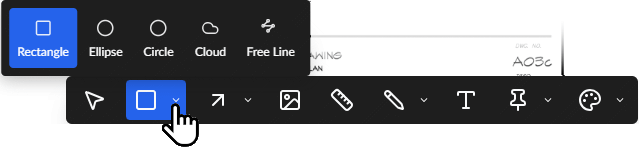
- To select a different shape, click the down-arrow next to the tool to open the menu and choose from the following:
Standard Shapes
Use these tools to quickly click and drag standard geometric boundaries over your plan sheet.
- Rectangle: Draw a perfect square or rectangular box.
- Circle: Draw a perfect circle.
- Ellipse: Draw an oval shape to highlight a specific area.
Cloud Markup
- Cloud: Create a clouded boundary to quickly draw attention to a specific region for review. (See "Highlight a Region with a Cloud Markup" for detailed guidance).
Custom Area
- Free Line (Polygon): Draw a custom, multi-sided polygon to outline and cover an area with an irregular shape. (See "Mark an Area with a Polygonal Shape" for detailed guidance).
Use the links below to jump to the markup shape you need help with:
- Draw Standard Shapes
- Highlight a Region with a Cloud Markup
- Mark an Area with a Custom Polygonal Shape
- Customize the Markup
Draw Standard Shapes
- Select the desired shape (Rectangle, Circle or Ellipse)
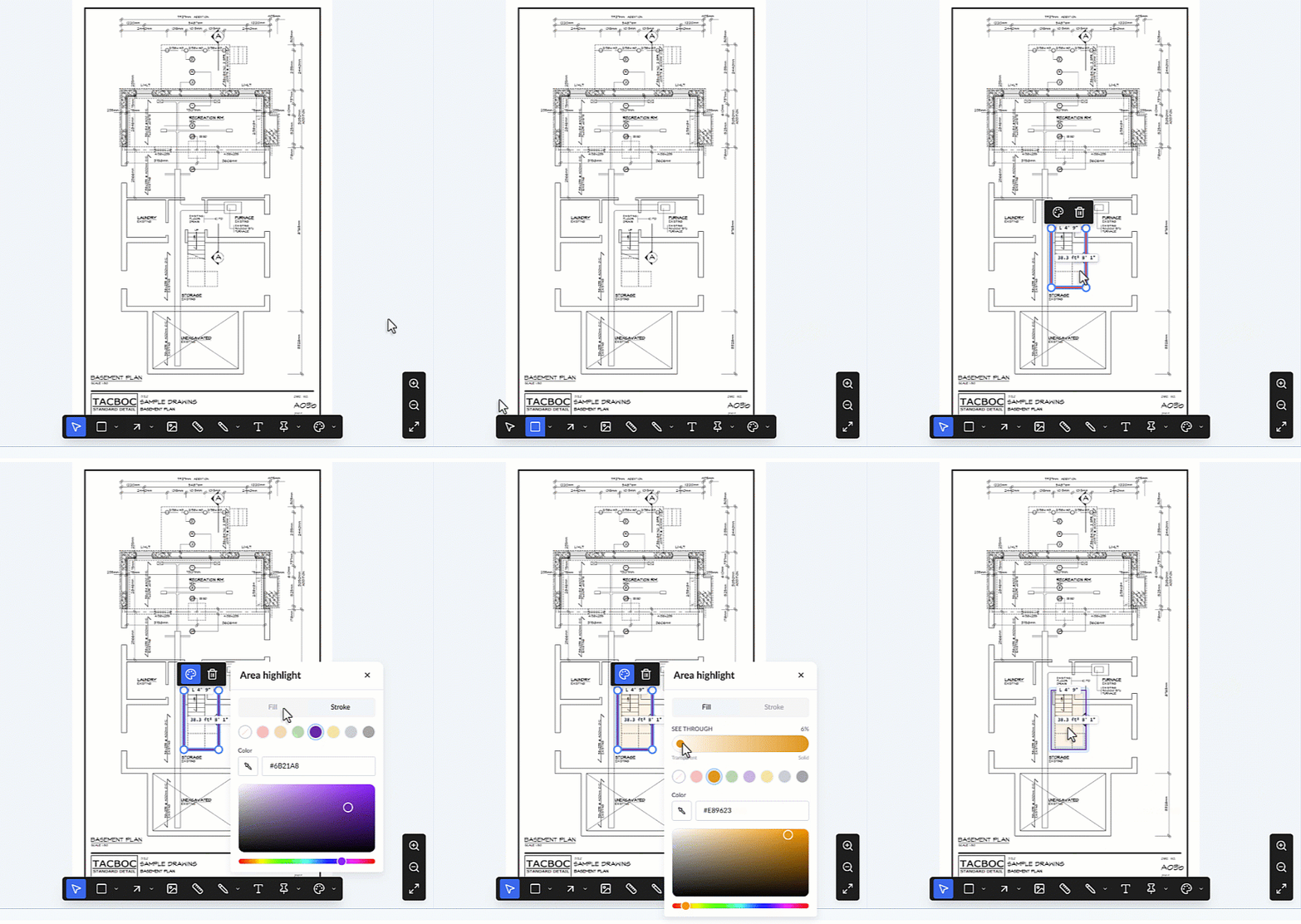
- Click and drag your cursor over the plan to roughly draw the shape.
- To reposition the markup, click and drag the shape to your precise target area.
- To resize the shape, click and drag any of its corner handles.
The markup is created with the default red strokes. You can customize its appearance by clicking the color palatte that appears above the markup or in the toolbar. See below for guidance.
Highlight a Region with a Cloud Markup
- Click the down-arrow next to the shape tool and select the 'Cloud' tool
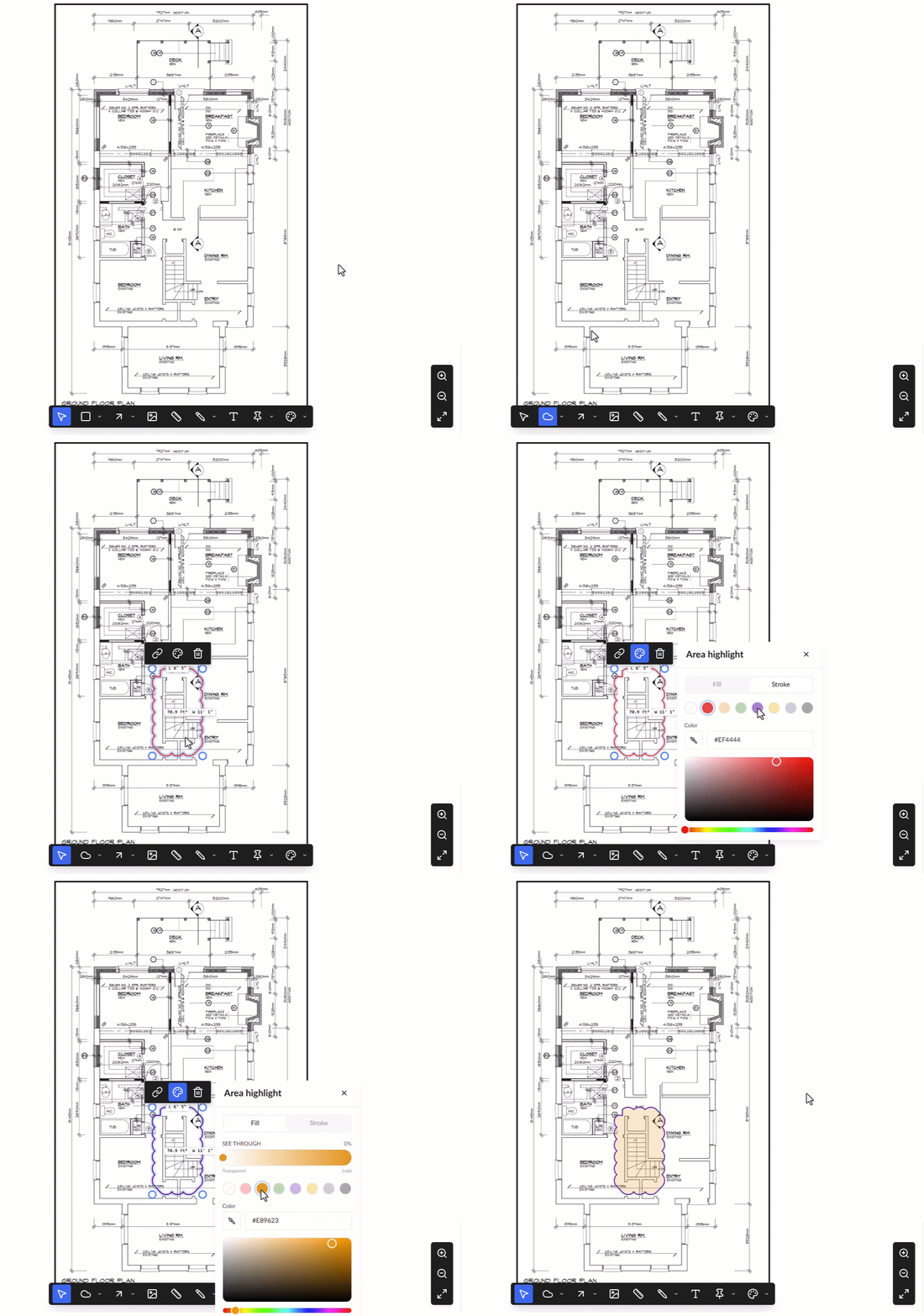
- Click and drag your cursor over the plan to roughly draw the shape.
- To reposition the markup, click and drag the shape to your precise target area.
- To resize the shape, click and drag any of its corner handles.
The markup is added with the default red color. You can customize its appearance by clicking the color palatte that appears above the markup or in the toolbar. See below for guidance.
Mark an Area with a Custom Polygonal Shape
- Click the down-arrow next to the shape tool and select the 'Free line' tool
- Click anywhere on the drawing to set the starting point of your polygon.
- Move your mouse and click at each corner to outline the area you want to mark.
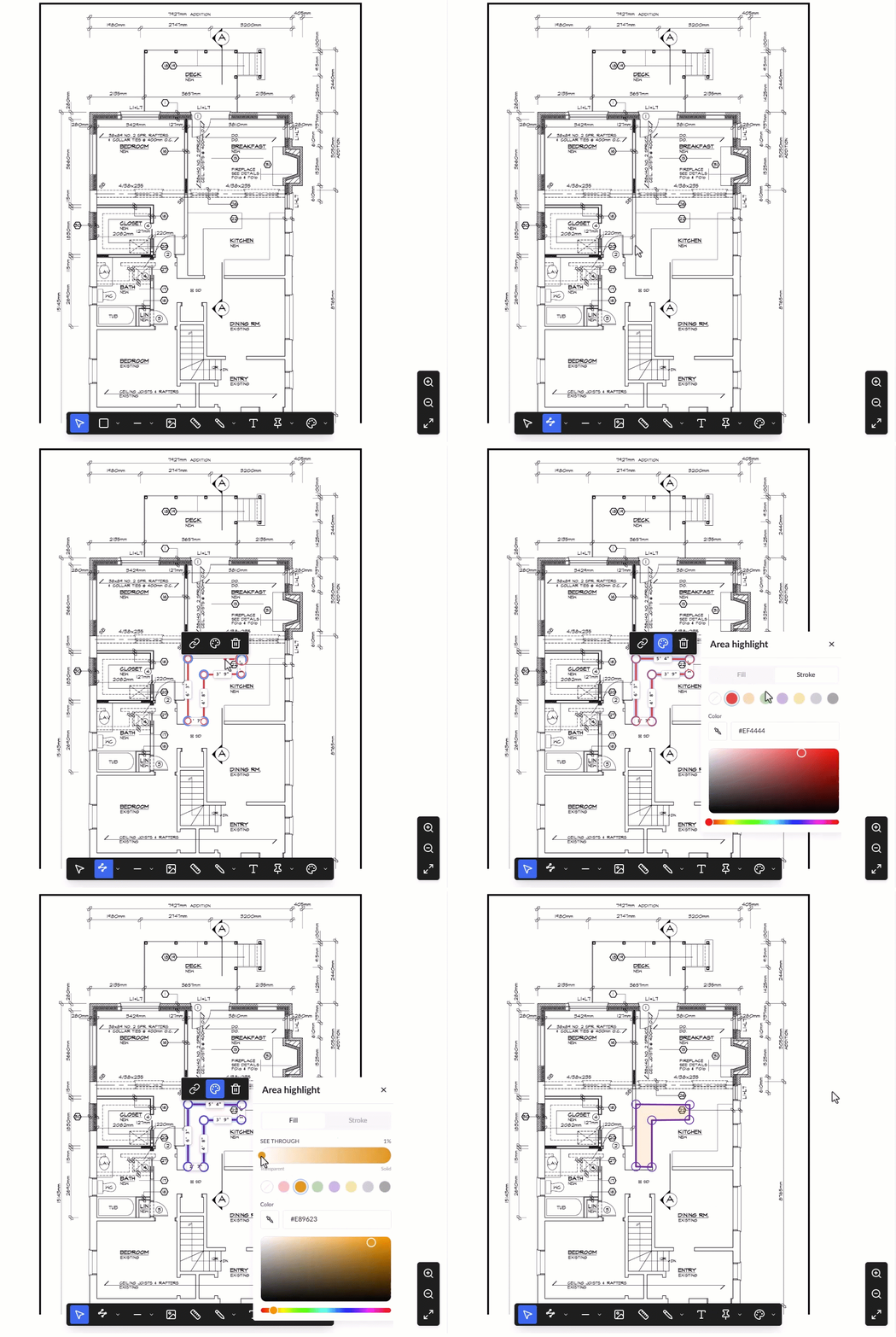
- To reposition the shape, click and drag it to the exact spot you need.
- To adjust the shape and size, drag the corner handles until it perfectly covers your area of interest.
- The markup is added with the default red color.
The markup is added with the default red color. You can customize its appearance by clicking the color palatte that appears above the markup or in the toolbar. See below for guidance.
Customize the Markup
- Click the color palette icon above to the markup or in the toolbar at the bottom to adjust the stroke color or add a color fill. See Format Stroke and Fill Colors for guidance.
You can also clone the markup to mark similar area on a different spot in the drawing. See Clone and Reuse Markups if you need guidance on it.
Every shape you add is automatically saved as a new layer within the "Current Markup" group, which is visible in the layer editor on the left side of your screen. From this editor, you can manage your shapes:
- Rename: Click the element's label in the editor to give it a brief, descriptive name to keep your markups organized.
- Lock: Hover over the element and click the
 icon to prevent accidental edits or deletion.
 - Hide/Show: Hover over the element and click the
 icon to temporarily hide or show the layer on your plan.
 - Delete: Hover over the element and click the
 icon to remove a mistake.
You can continue selecting tools to add more markup elements as needed. Once you are finished annotating the plan, you must save the layer group. See Publish Markups for detailed instructions on finalizing your work.
Was this article helpful?
That’s Great!
Thank you for your feedback
Sorry! We couldn't be helpful
Thank you for your feedback
Feedback sent
We appreciate your effort and will try to fix the article