The Portfolio Safety Dashboard gives project managers a consolidated view of safety performance across all active projects—covering incidents, near-misses, root causes, treatments, and overall compliance. It surfaces trends and patterns across jobsites, helping you identify risks early, improve safety practices, and drive safer project execution.
With built-in cross-filtering, any selection you make in a chart or visualization instantly updates all others, allowing you to focus on specific incident types, locations, contractors, or time periods. This interconnected view helps you quickly drill down, uncover patterns, and perform deeper analysis with ease. For detailed guidance, see the Cross Filtering Options section.
To open the portfolio-level safety dashboard
- Ensure you are in the Portfolio console, If not:
- Click the app launcher icon
 in the top-right and select 'Portfolio.'
- Click the app launcher icon
- Click 'Analytics' on the top and 'Safety Dashboard' on the left
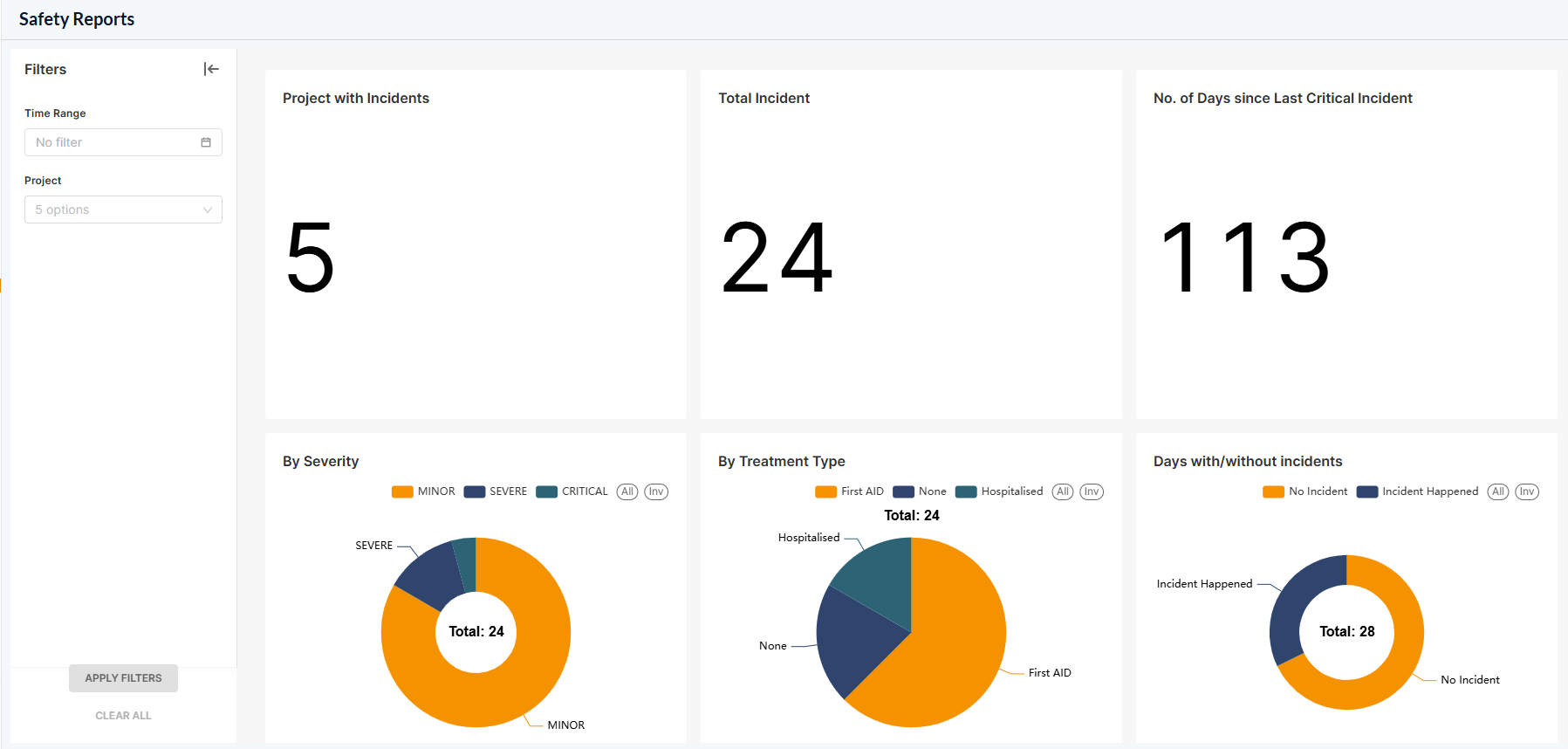
The dashboard shows the following cards and charts:
- Project with Incidents – The total number of projects that have reported at least one safety incident.
- Incident Count – The total number of safety incidents and accidents reported across all projects.
- Last Critical Incident – Shows how many days have passed since the most recent incident marked with 'Critical' severity level has been reported.
- Incidents Count by Severity
- Incidents Count by Treatment Type
- Days with/ Without incidents
- Distribution By Root Cause
- Incidents by Week
- Incidents by Projects and Treatments
- Incidents by Projects and Root Causes
- Incidents by Projects and Severity
Incidents Count by Severity
The donut chart shows the total number of incidents categorized by their severity levels.
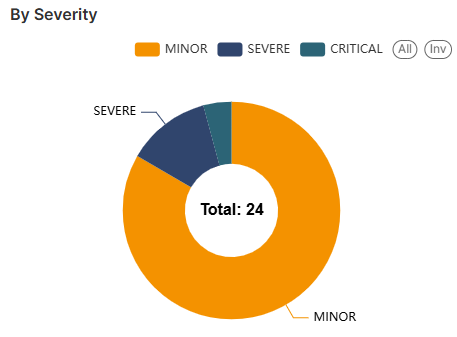
The legends are shown at the top.
- Use the left and right arrows to scroll the legend strip
- Hover your mouse over a sector to see how many incidents fall under each severity level.
- See Cross Filtering Options and Zoom and Filtering Options to focus on particular data on the chart.
Incidents Count by Treatment Type
The pie chart shows the breakdown of incidents based on the type of treatment provided to the injured individuals.
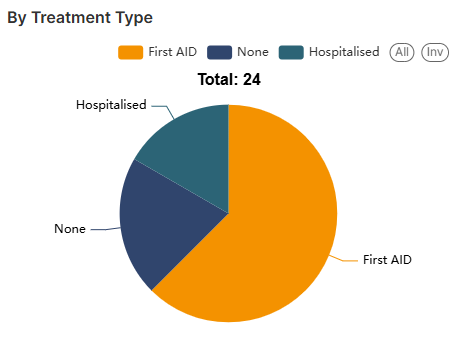
The legends are shown at the top.
- Use the left and right arrows to scroll the legend strip
- Hover your mouse over a sector to see how many incidents fall under each treatment type.
Days with/ Without incidents
Displays the breakdown of working days—from the earliest project start date to today—showing how many days had reported incidents and how many were safe days with no incidents.
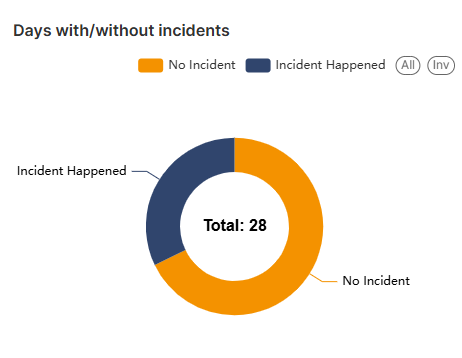
The legends are shown at the top.
- Use the left and right arrows to scroll the legend strip
- Hover over a sector to see the percentage of incident and non-incident days
- See Cross Filtering Options and Zoom and Filtering Options to focus on particular data on the chart.
Distribution By Root Cause
The donut chart shows how incidents are distributed across different contributing factors, revealing patterns that may need attention.
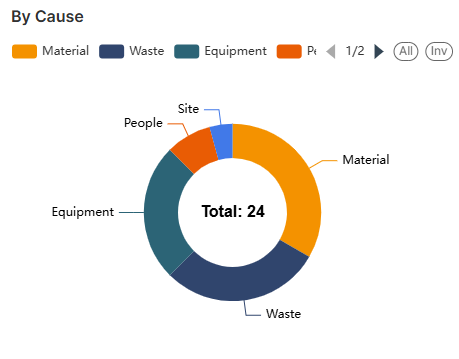
The legends are shown at the top.
- Use the left and right arrows to scroll the legend strip
- Hover your mouse over a sector to view the number of incidents attributed to different causes.
- See Cross Filtering Options and Zoom and Filtering Options to focus on particular data on the chart.
Incidents by Week
The bar chart shows the number of incidents recorded each week, spanning from the earliest project start date up to today.

- Place your mouse on a bar to view the number of incidents in that category.
- See Zoom and Filtering Options to focus on particular data on the chart.
Incidents by Projects and Treatments
The bar chart displays the number of safety incidents reported for each project, with each bar further broken down by the type and level of treatment provided to the injured individuals. This helps you compare incident severity and response across projects at a glance.

- Place your mouse on a bar to view the number of incidents in that category.
- See Zoom and Filtering Options to focus on particular data on the chart.
Incidents by Projects and Root Causes
The bar chart shows the number of safety incidents reported for each project, with each bar further segmented by the identified root causes. This breakdown helps you quickly compare contributing factors across projects and spot patterns that need attention.
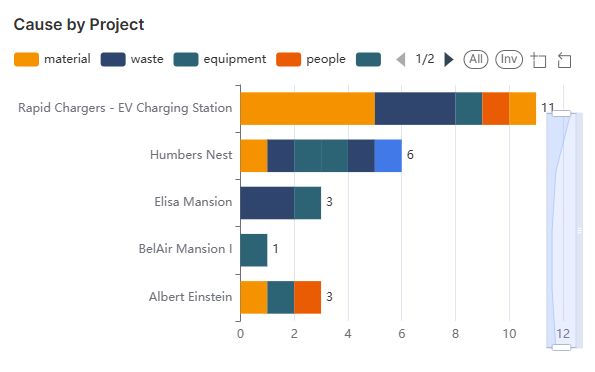
- Place your mouse on a bar to view the number of incidents in that category.
- See Zoom and Filtering Options to focus on particular data on the chart.
Incidents by Projects and Severity
The bar chart shows the number of safety incidents reported for each project, with each bar further segmented by incident severity. This visual breakdown makes it easy to compare risk levels across projects and identify where critical issues are concentrated.
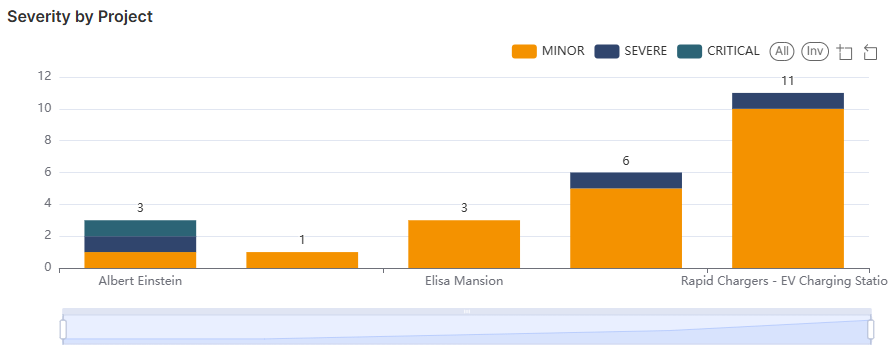
- Place your mouse on a bar to view the number of incidents in that category.
- See Zoom and Filtering Options to focus on particular data on the chart.
Cross Filtering Options
The cross-filtering feature enables you to choose a category on one chart and instantly apply that category as a filter across all visualizations. This action refines the data displayed in the other charts, showing only the statistics related to the selected category of submittals. Additionally, you can layer multiple filters by selecting different sectors across the charts, allowing for deeper, more specific analysis of the filtered results.
Note: You can add custom filtering options only from the donut/pie charts and the tables in the dashboard.
- Click on any sector within the donut charts to filter other charts with that category as filter criteria
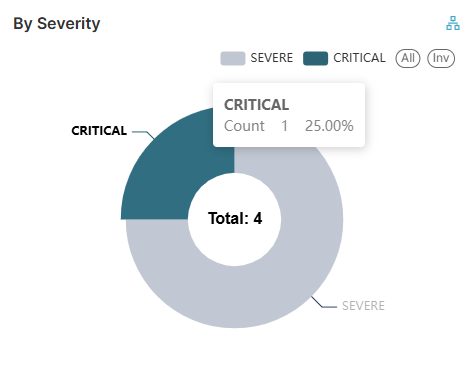
- Repeat the process on the other charts successively to drill down the results
The Filters pane on the left shows the successively applied filters
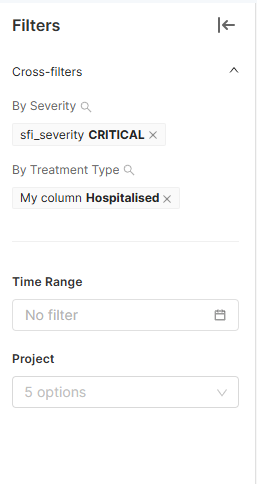
- Click the 'X' mark beside a filter to remove it.
Filter by Time Range
- Click the 'Time Range' filter
- Select the range type from the drop-down menu and choose the desired time range
You can also set a custom time range with a specific date and time
Click the'Apply' button to set the filter for the selected time range
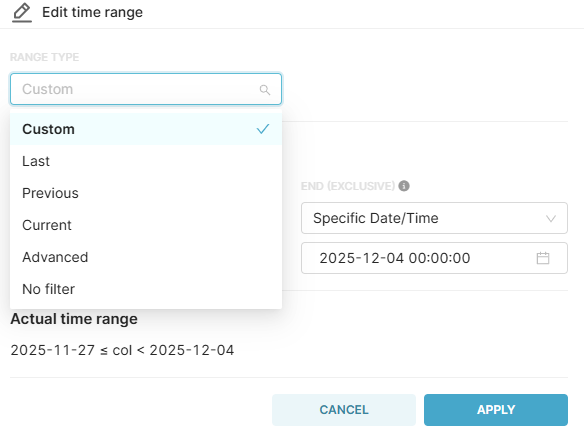
Illustration:
For example, if you want to view statistics of incidents that are in 'Critical' severity and require treatment from the hospital, you can cascade these two filters from the respective charts:
- Click the 'Critical' sector in the 'Severity' chart
All charts are filtered to show only the statistics of incidents that are critical in severity
- Then click 'Hospitalised' in the 'Treatment Type' chart.
The charts now show only the incidents that are critical and have had members hospitalised.
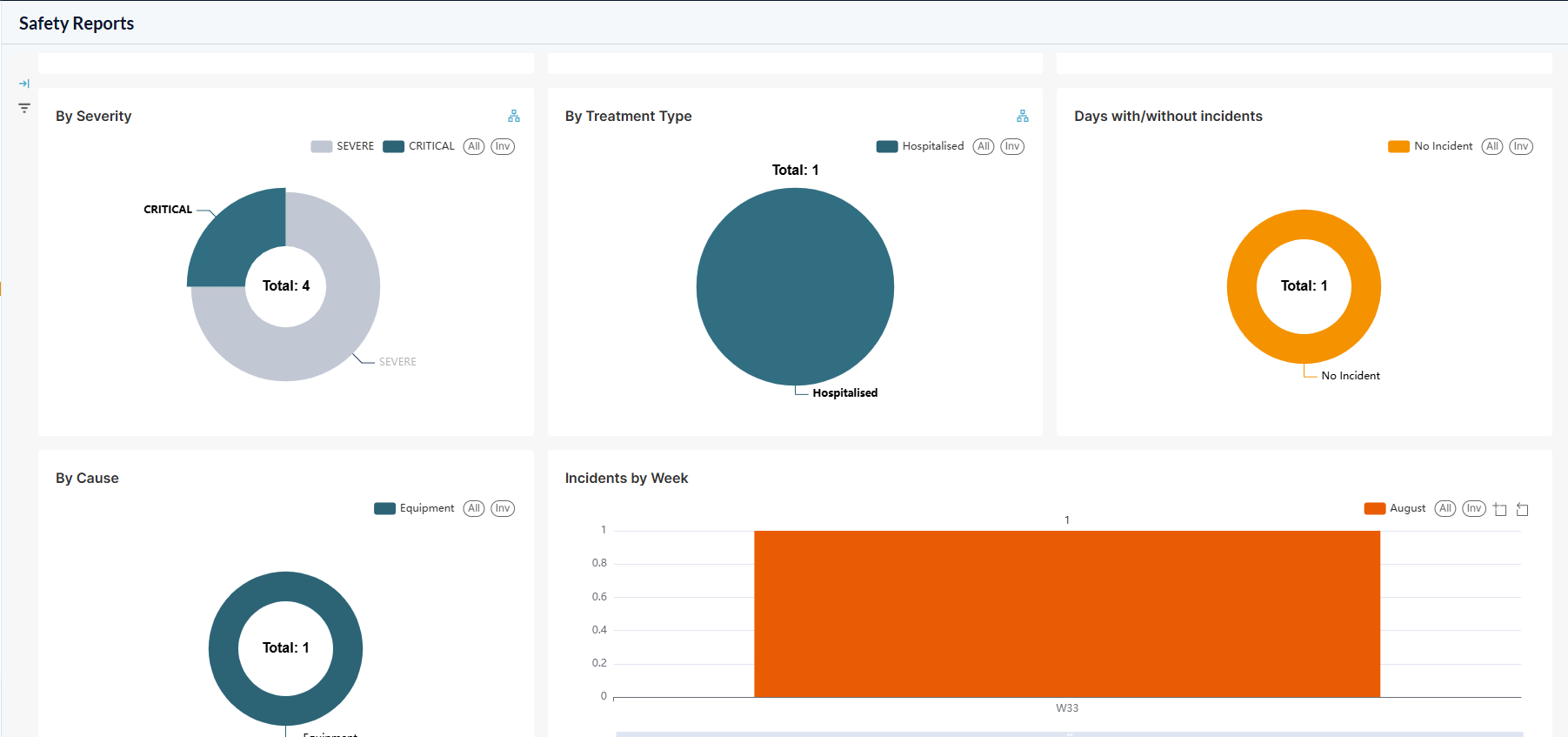
The 'Filters' pane on the left shows the filters applied in order.
- Click the 'X' button beside a filter to remove it
Zoom and Filtering Options
Zoom option:
This function is applicable to all bar charts to get a precise view of a particular area.
- Use the sliders at the bottom or sides to zoom the chart to a required timeline

- Click
 , drag, and select an area to zoom in to view data on that particular area
 - Click
 to reset the zoom
Filtering options:
Filtering options are available for both pie charts and bar charts.
- Click on the legends at the top of the particular chart to hide/show those categories in the chart. This filter option is applied only to that particular chart.
- Click 'All' to clear all filters and show all categories
- Click 'Inv' to invert your selection of categories
Was this article helpful?
That’s Great!
Thank you for your feedback
Sorry! We couldn't be helpful
Thank you for your feedback
Feedback sent
We appreciate your effort and will try to fix the article